
The register answers two questions: how much money should be in the drawer now, and why there is a different amount. The answer to the second is worth more, and reconciliation is built for it.
Where it is in the CRM
- Shifts, operations, reversals: the Cashboxes section.
- Paying for a visit: in the visit itself.
- Cash reconciliation: Reports → Cash reconciliation.
The shift
One register has one open shift at a time. At opening, the starting balance is recorded. During the shift the expected balance is calculated from actual movements: start plus income minus expenses. Transfers between your own registers and currency exchange are excluded: that is moving your own money, not income.
At closing, the cashier enters the amount counted by hand. The difference between the counted and the expected is recorded: minus is a shortage, plus is a surplus. The closing note explains why.
Paying for a visit
A visit is paid in cash, by card or from the client's balance. Partial payment is possible: the visit stays open until paid in full. The system does not accept overpayment.
A package and a gift card are applied before payment and reduce the amount due. If the booking was already fully paid by prepayment, the visit closes with a zero payment, and the same money is not posted twice.
A fiscal receipt is issued with a button and is not duplicated by a second press. At payment, consumables are written off, and if the write-off failed the cashier sees it in the response: the stock does not block the payment, but it reports the problem.
Reversal instead of deletion
The cash book does not lose history. A wrong operation is not deleted but reversed: an opposite operation for the same amount is created with a reason, and the two reference each other. Reversing twice is not possible. Cancelling a paid visit does the same automatically: the income is reversed and the goods return to stock.
Cash reconciliation
The reconciliation report takes the sales for a period, paid visits, prepayments on bookings without a visit, packages and gift cards sold, and the register income for the same period, and matches them one by one. Refunds reduce both sides.
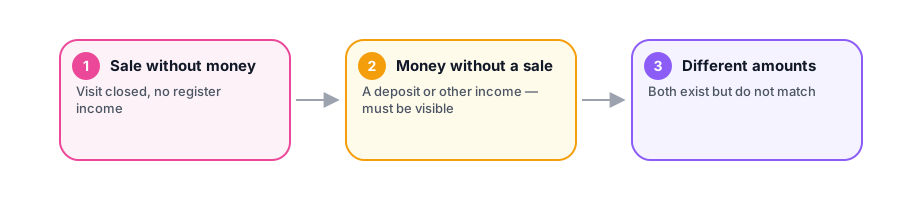
Three types of discrepancy:
- a sale without money: the visit is closed, the register had no income;
- money without a sale: a deposit or other income. That is normal, but it must be visible;
- different amounts: both the sale and the income exist, but they do not match.
Topping up a client's balance is not a sale: it is money in safekeeping, and it becomes a sale when deducted. A visit with a full refund is not shown as a discrepancy.
The total difference is the sum of the discrepancies found, not one column minus the other. Subtraction used to declare a discrepancy exactly the money that reconciliation itself had recognised as normal, and a salon would see "discrepancy 6380 ₴" with a list explaining 1300. The register counts as reconciled only when the discrepancy list is empty: a shortage of 1000 and a surplus of 1000 add up to zero, but they are two problems, not none.
Reconciliation is available on every plan: a salon has the right to find its own shortage regardless of how much it pays for the CRM.


Comments
No comments yet. Ask your question — we answer within a day.